While the Modi government cannot allow CEC Gyanesh Kumar to quit on his own, the students’ agitation, which has once tasted big success, cannot afford a softer recourse, as capital Delhi braces up for the great showdown between the two sides on October 10. India faces its biggest political impasse of the last few decades
Ranjit Bhushan
Indian Prime Minister Narendra Modi, who completed 25 uninterrupted years as the head of a government on October 7, 2026, marking a continuous journey that began when he took oath as the Chief Minister of Gujarat on October 7, 2001, and win the 2014 general elections, carrying on as Prime Minister, ranks among the most successful Indian politicians since the country gained independence in 1947.
The day was special for India’s Prime Minister. His party, the Bharatiya Janata Party (BJP), hosted a major event at the Indira Gandhi Indoor Stadium in New Delhi, where Modi addressed a large, festive gathering of acolytes. Later, the Federal Cabinet passed a special resolution congratulating him for 25 years of continuous leadership guided by the principle of “Nation First and Citizen First”.
The SIR Storm
Such festivities, however, scarcely conceal some sombre realities that he and his third-term government currently face.
India’s Supreme Court has demanded accountability from the government and the Election Commission over a controversial exercise that has led to the deletion of tens of millions of voters from the electoral roll and prompted mass protests. Nearly a billion people in the world’s biggest democracy are being asked to show documents to prove that they should keep the right to vote.
What’s currently spawning a countrywide public revolt is that the exercise – the Special Intensive revision or SIR – billed by an Election Commission appointed by PM Modi as cleaning India’s voter roll of duplicates and discrepancies, has so far expunged a whopping 130 million names, more than the population of several small countries put together.
The exercise, which began last summer in Bihar before being expanded to every voter in the country, has struck the biggest blow to electoral integrity in India’s more than seven decades as a republic, say leaders and activists.
Tens of millions of voters have been flagged by algorithms for deletion over anomalies in their information. Millions who have appealed their deletions remain stuck in adjudication, deprived of their right to vote during close-fought elections earlier this year. Some removed for being dead are challenging the decision, saying they are fine, alive and kicking.
Students Take Centre Stage
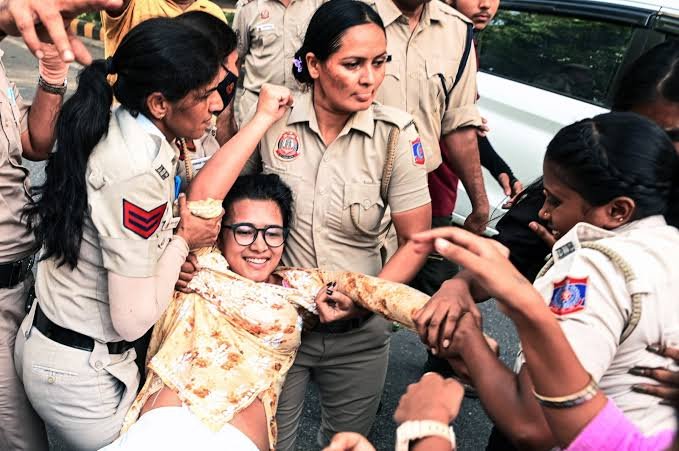
Neha Bora, national president of All India Students’ Association (AISA), said the youth protests were aimed at seeking accountability from an individual and an institution that were expected to protect democratic processes. “People would continue to raise questions over democracy, electoral rolls and the right to protest,’’ she reiterated.
Bora, among the brightest of the young student protestors to emerge on the Indian scene in 2026, said that the students’ protest movement had evolved into a broader citizens’ movement.
Tens of millions of voters have been flagged by algorithms for deletion over anomalies in their information. Millions who have appealed their deletions remain stuck in adjudication, deprived of their right to vote during close-fought elections earlier this year. Some removed for being dead are challenging the decision, saying they are fine, alive and kicking.
A Poll Body Under Fire
Protesters are calling for the resignation of Gyanesh Kumar, Chief of the Election Commission (EC), a rare poll body in the developing world regarded globally as the “gold standard” for managing the world’s largest democratic exercises. Its global reputation stems from its massive logistical execution, pioneering technology, and international capacity-building.
That fair name seems to be taking a hit.
“The heart of our democracy, which is the right to vote, is at great peril,” Rohinton Nariman, a former Solicitor General of India and a Supreme Court judge, said in a lecture last week.
Public anger is turning into widespread protests, with central Delhi’s Jantar Mantar as its epicentre, even as civil society activists pile up evidence that the exercise could be disenfranchising those seen as potential opponents of Modi and his ruling BJP, particularly ahead of pivotal state elections, mainly the political bellwether province of UP early next year.
Protests Spread Across India
The opposition coalition – the INDIA bloc headed by the Congress party, student organizations, and the prominent Cockroach Youth movement – have joined hands accusing the government of massive “vote theft”. The protestors are demanding the ouster of Gyanesh Kumar, an immediate halt or rollback of the SIR exercise, and a full return to paper ballots to restore transparency.
Major rallies have gripped New Delhi, Mumbai, Bengaluru, Patna and elsewhere. Protesters have deployed striking imagery, such as covering themselves in white sheets to symbolize being declared “dead” on voter rolls.
In Bengaluru, actor Prakash Raj criticised the SIR exercise at a ‘People’s Tribunal’ last week, alleging that the voter-roll revision is disproportionately affecting minority, tribal and Muslim voters. He said the protest’s objective is to scrap SIR and restore citizens’ voting rights, rather than simply seek the removal of Gyanesh Kumar.
The Cockroach Janta Party (CJP), an Indian youth-based satirical political movement founded by Abhijeet Dipke, led a massive and successful protest movement in June 2026 at Jantar Mantar, which led to the resignation the then federal education minister Dharmendra Pradhan, over widespread paper leaks and irregularities in competitive exams like NEET, plus parliamentary accountability and reservations.
Now the cockroaches are back, after a brief lull.
Calls for CEC Gyanesh Kumar’s Resignation
The trigger for the current round is a major investigative report published by daily newspaper The Indian Express that revealed deep fractures inside the ECI itself. The investigation disclosed that the other two Election Commissioners, Sukhbir Singh Sandhu and Vivek Joshi, had formally objected at least 14 times over 10 months to decisions regarding voter additions and deletions. They reportedly flagged Chief Commissioner Kumar’s actions as “unauthorized and illegal,” providing momentum to the opposition’s narrative that the independent watchdog’s leadership is acting unilaterally.
Large-scale street protests have choked major hubs, gridlocking the financial capital of Mumbai and the political centre of New Delhi. High-profile opposition marches from Parliament toward the Election Commission headquarters have led to hundreds of detentions, including prominent MPs and student leaders. Not surprisingly, much of the street-level momentum is driven by the student-led “Cockroach” movement.
The political temperature has gone up significantly when heavyweights from the INDIA bloc, including prominent leaders like Rahul Gandhi, Priyanka Gandhi, and Akhilesh Yadav, joined in, leading a high-profile march toward the Election Commission headquarters in Central Delhi.
“Voting is the most basic right of any citizen, but because of the actions of Gyanesh Kumar and the Election Commission, that right is under attack,” said Radha Kumar, 22, a student activist at Jantar Mantar. Adds Sanjay Rajan, another young protestor: “So many millions of people have lost their votes and aren’t even recognised as citizens of India anymore. This attack on our democracy must stop.’’
Authorities have responded by deploying riot police, enforcing strict bans on public gatherings, restricting internet access, and detaining hundreds of demonstrators and lawmakers under strict prohibitory orders.
The Supreme Court of India has stepped in, refusing to issue an immediate stay on the voter roll revision but formally seeking records from the EC regarding the legality of their unilateral procedures and warning that any illegalities will carry consequences.
The participants are not too impressed by this judicial intervention and want more. “The throttling of Citizens’ fundamental right to peaceful protest by the govt & its police is happening under the nose of the Supreme Court. It is also leading to a dangerously volatile situation. Why is the SC not intervening Suo Moto to direct the govt/police to allow peaceful protests,’’ tweeted veteran lawyer, Prashant Bhushan.
Allegations of Targeted Disenfranchisement
Significantly, protests say that the SIR roll culling disproportionately targets marginalized communities, migrants, and opposition voters to benefit the BJP. Topping the list of infamy are India’s 200 million Muslims, who appear to have been disproportionately picked upon.
The Monitoring Committee of Indian Muslims, backed by Jamiat Ulama-i-Hind and other groups, protested at Jantar Mantar. They raised concerns about selective bulldozer demolition actions, voting rights exclusions, and the partial demolition of the historic Shahi Masjid in Ujjain ahead of Simhastha 2028, a holy Hindu festival that comes once every 12 years.
Critics and community leaders like Asaduddin Owaisi of the All India Majlis-e-Ittehadul Muslimeen (AIMIM) and organizations such as Citizens for Justice and Peace (CJP) allege that the SIR process is being misused through bulk Form 7 applications to selectively delete minority, Adivasi, and Muslim voters.
Weaponisation of Form-7
The Election Commission’s campaigns for voter awareness, when highlighting the significance of Form-7, speak of the need to fill up and submit the form to the concerned election authorities when either getting the name of a deceased family member deleted from the electoral rolls or seeking to remove from the voters’ list the name of a neighbour or a relative who has shifted residence to a new constituency.
“Form-7, however, is now not being viewed in such a benign way any longer. Against the backdrop of the ongoing SIR, it is no longer seen as a facility whose purpose is limited to one’s family or vicinity. Allegations are flying thick and fast that the form has been weaponized by the ruling BJP to undertake mass deletion of electors,” said the Association of Democratic Rights or ADR.
ADR is an apolitical, non-partisan NGO that works to improve governance and electoral transparency in India.
Earlier this year, Congress general secretary K.C. Venugopal wrote to the Election Commission flagging “serious and grave concerns” over what he described as a blatant misuse of Form-7 during the claims and objections phase of the SIR. Venugopal claimed that Form-7 was being misused to carry out “mass scale, targeted exclusion of eligible voters’ names” from the electoral roll.
Firmly denying any wrongdoing or partisan manipulation, the Election Commission maintains that the revision is standard procedure designed to scrub duplicate, deceased, and ineligible entries to secure electoral integrity.
Government spokespersons have dismissed the protests as a coordinated attempt by opposition parties to turn their recent electoral losses into a manufactured conspiracy.
Addressing a press conference at the party headquarters in New Delhi, BJP national media convenor Siddharth Yadav accused the Opposition of making ‘baseless’ allegations against constitutional institutions to cover up its electoral failures. “Why did the Congress not object when large numbers of names were added to or deleted from electoral rolls without an SIR during the UPA years. There have been deletions of around 13.58 lakh names from Delhi’s electoral rolls in 2013 and large-scale additions and deletions in Maharashtra in 2014,” Yadav said.
An Unbreakable Logjam
In other words, the political stalemate is complete. The youth movement shows no signs of slowing down, with the opposition and activist groups calling for escalated “Dilli Chalo” or march to Delhi mega-rallies.
Days after the media revelations about the Election Commission, CJP’s founder, Abhijeet Dipke, announced that if Election Commission boss Kumar did not resign over the controversy, the “Cockroaches” would resume their agitation until he stepped down, a none-too-subtle threat and reference to their successful foray in June.
Dipke said that protests would kick off a nationwide movement, with more agitations planned in Delhi, Goa, Kolkata and Bengaluru. After issuing such solemn deadlines, it would be a body blow for the youth activists to take a softer course of action.
On the other side, it is not easy – or even impossible – to impeach the Chief Election Commissioner. Removing him requires strict constitutional numbers and a special majority in both houses of Parliament, which the opposition in India lacks.
And if Kumar quits on his own, it will significantly damage Prime Minister Modi’s position and a tacit admission that there were indeed wrong doings in fixing the voters list with the grand SIR exercise.
As far as logjams go, this is about as eternal as it gets.