Tridib Raman
The current political situation in Uttar Pradesh is putting pressure on the saffron (BJP) leadership. Ground reports and public opinion surveys are also telling a different story. Within the party itself, swords are drawn between Yogi’s supporters and his opponents. Keeping this restlessness in mind, Delhi is perhaps thinking of something big. According to sources, the old proposal of dividing Uttar Pradesh into four parts is being reconsidered on the principle of “neither the bamboo will remain nor the flute will play.” This is an old idea. On 21 November 2011, the then Mayawati government, which was in power in Uttar Pradesh, had sent a proposal to the Centre to divide the entire state into four parts. The proposal intended to split UP into Awadh Pradesh, Purvanchal, Bundelkhand and West Pradesh. It was argued that dividing UP in this manner would not only decentralise power but would also make it easier to address the larger expectations of the people in relatively smaller states, and would make access to the government simpler and more convenient for ordinary citizens. When this proposal reached the then central government, the UPA-2.0 government led by Manmohan Singh was in power in Delhi. At that time, the then Home Secretary R.K. Singh sought several clarifications on the proposal and sent it back to Lucknow. Lucknow had already understood Delhi’s intentions, so the Mayawati government also thought it better to put the proposal in cold storage. Now it is being heard that Delhi is dusting off this same proposal and polishing it afresh. If everything goes according to Delhi’s wishes, the Home Ministry can get this proposal passed by the Cabinet and send it to the President for approval. Om Prakash Rajbhar had also given similar indications in his Deoria rally held in September. If this proposal is indeed passed by the Cabinet, the UP elections could also be postponed further, and Delhi could put a mirror to Yogi’s lofty political ambitions.
SP-Congress Alliance on the Cards
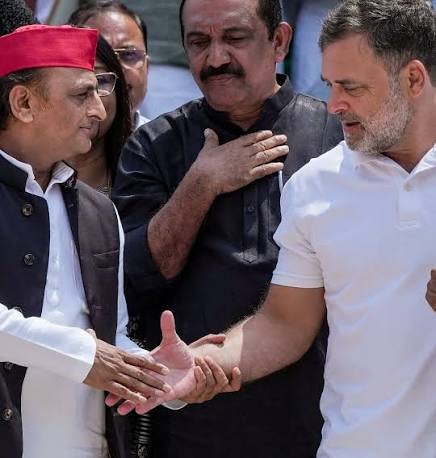
The constantly shifting political situation in Uttar Pradesh has forced the Samajwadi Party (SP) and Congress to set aside all their past grievances and come together. Recently, during the launch of Sonia Gandhi’s book in Delhi, Akhilesh Yadav casually told Rahul Gandhi, “Your people (Congress workers) keep making unnecessary statements against the SP.” Rahul took Akhilesh’s words somewhat seriously, and since then, the loudmouthed Congress leaders in UP have been effectively silenced. In another significant development, Rajendra Pal Gautam, the Congress’s in-charge for Uttar Pradesh, had prepared a list of 181 prospective candidates for the Assembly elections in consultation with state Congress working president Imran Masood. However, the list was hastily withdrawn. Akhilesh had wanted Congress to make Priyanka Gandhi the party’s election in-charge for UP so that day-to-day coordination between the two parties would become easier. However, sources say Priyanka politely declined the proposal, saying she is the MP from Wayanad in Kerala and the expectations of the people of Kerala from her are much higher. She added that she could still handle all these tasks from behind the scenes. It was then decided that Akhilesh, Rahul, and Priyanka could sit together and finalise the seat-sharing formula for UP. Congress’s state president Aradhana (alias Mona Mishra) could also be included in this loop. It is worth noting that Aradhana’s father, Pramod Tiwari, shares a very close relationship with the Mulayam family. A close source associated with Akhilesh now says that the SP may leave 65 to 80 seats for the Congress.
Will Bhupendra Patel Be Replaced in Gujarat?
It is no mere coincidence that Prime Minister Narendra Modi’s visits to Gujarat have suddenly intensified in recent times. On his last trip, he arrived straight from Bengaluru in Gandhinagar at dinner time. As per the pre-scheduled programme, he was supposed to visit the famous Ambaji temple in Banaskantha district the next morning (Saturday) on the occasion of Labh Panchami. However, the Prime Minister’s temple visit was cancelled at the last moment with the explanation that “a huge crowd of devotees gathers at Ambaji temple on this occasion, so the PM cancelled his Banaskantha visit himself to avoid any inconvenience to the devotees.” It is worth recalling that former Prime Minister Indira Gandhi also had unwavering faith in this Ambaji temple. Whenever she visited Gujarat, she would invariably go there for darshan. PM Modi himself has visited this temple several times. Anyway, when Modi reached Gandhinagar late that evening from Bengaluru, a “gala dinner” had already been arranged by the state government. All ministers of the Bhupendra Patel government, the Chief Minister, and the state BJP president had been strictly instructed in advance that they must be present at this dinner. Sources say that even the commandos deployed for Modi’s security and important bureaucrats were not allowed inside the dinner hall. A political analyst who closely understands Modi’s political style describes this as the Prime Minister’s familiar “guerrilla-style” politics. Even while holding power in Delhi for the past twelve years, Modi’s heart still remains attached to Gujarat and its politics. Despite not being physically present there, he remains fully updated about every development in Gandhinagar. According to sources, the manner in which the Prime Minister revealed his detailed knowledge of the day-to-day activities of Bhupendra Patel’s ministers clearly indicates that this dinner is likely to weigh heavily on the Chief Minister and several of his ministers. There is also speculation that the leadership of the Gujarat elections due in 2027 may be entrusted to some other leader instead of Bhupendra Patel. The new Chief Minister and the face of his cabinet could also look somewhat different then.
Has SpiceJet Found a Saviour?

The turbulent flight of SpiceJet Airlines and its ambition to challenge the skies seem to have finally found a secure destination. The airline, which had reached the brink of collapse, has now received the backing of one of the country’s leading industrialists, who is prepared to pump more than Rs 5,500 crore into the aviation company over the coming days. It was only last week that the Directorate General of Civil Aviation (DGCA) issued a show-cause notice to the company over flight cancellations, delays in departures and alleged operational irregularities. Following this, the company’s shares plunged to Rs 9.74. It may be recalled that the company has been looking for a buyer since 2022. After obtaining approval from its board, the airline had drawn up a plan to raise Rs 5,500 crore for itself, but the plan could not materialise. On November 17, the DGCA issued another show-cause notice to the airline, asking it to respond within seven days as to why most of its flights were grounded and when the company would clear the mounting dues it owed to various airports. Now, even the ground-handling company Dnata has stopped providing its services to the airline. For the record, the man at the helm of this company is Ajay Singh, who enjoys the government’s favour and holds approximately 25 per cent of the company’s shares, of which 12 per cent are held by him personally. The leading industrialist has therefore told Ajay Singh that he should sell his stake. He would, however, continue as a director in the company, but would have no interference in its day-to-day operations. The company’s employees have not received their salaries for several months, and payments to numerous vendors are also pending. They have therefore been told that as soon as the money comes in, they should first clear their outstanding dues. Whatever the eventual outcome, this industrialist, who enjoys the government’s favour, has certainly given SpiceJet an opportunity to spread its wings and take flight once again.
Is Shinde Getting Closer to the Congress
The changing body language of Shiv Sena leader Eknath Shinde has created considerable unease in the saffron camp. Is it merely a coincidence that Union Home Minister Amit Shah has visited Maharashtra nearly six times over the past five months? And his visits were not confined to Mumbai alone; he also travelled to Nagpur and Pune. The latest case concerns the cooperative banks in Maharashtra’s Sangli and Satara districts, where elections for the posts of chairman and vice-chairman were held on November 20. In these elections, Shinde did not hesitate to join hands with the Congress, much to the BJP’s discomfiture. As a result of Shinde’s alliance with the Congress, Mahendra Lad, a Congress leader, has become the chairman of the Sangli District Cooperative Bank after nearly 22 years. Meanwhile, Tanaji Patil from Shinde’s party has been elected vice-chairman. More or less the same political drama unfolded in Satara, where Shinde joined hands with the NCP (Ajit Pawar faction) to gain control of the Satara District Cooperative Bank. This was despite the BJP having the largest share of representation on the board. The 21-member board here comprises nine BJP directors, eight from the NCP (Ajit Pawar faction) and four from Shinde’s Shiv Sena. Here, too, Shinde turned the BJP’s entire game upside down. The NCP (Ajit Pawar faction) candidate was elected chairman, while a candidate from Shinde’s party became vice-chairman. Interestingly, the BJP and Shinde’s faction had contested the elections for membership of these cooperative bank boards together. But when the time came to elect the chairman and vice-chairman, Shinde showed his true colours. Shinde had adopted a similar position earlier during the MLC elections, when he opposed the BJP and fielded his own candidates. In Pune and Sambhaji Nagar, Shinde even extended his support to the Sharad Pawar faction. Differences between Shinde and the BJP had also surfaced during the Zilla Parishad elections, when the BJP ignored the greater numerical strength of the Shinde faction and installed its own people in key positions. Needless to say, cracks have now appeared in the BJP-led Mahayuti alliance in Maharashtra. Perhaps this is precisely why the BJP’s Chanakya has had to make repeated visits to Maharashtra, in an effort to repair the damage.
RSS Has Thrown Its Full Weight Behind Uttar Pradesh
As the electoral battle in Uttar Pradesh becomes increasingly interesting with each passing day, the RSS, too, appears to have identified a significant role for itself. Sources say that the RSS leadership is continuously monitoring ground-level feedback related to the Uttar Pradesh elections. In addition, several ground surveys and opinion polls are being conducted in the state under the RSS’s guidance. The findings emerging from this feedback and these ground surveys have undoubtedly begun to cause concern within the Sangh as well. The biggest concern for the RSS is the internal factionalism prevailing within the BJP. While most of the state’s senior leaders are said to enjoy the blessings of the leadership in Delhi, there is also a sizeable group of leaders who are devoted to and supportive of Chief Minister Yogi Adityanath. It is believed that Yogi also enjoys the indirect support of the RSS leadership. Consequently, the RSS has already shifted into active mode ahead of the forthcoming Uttar Pradesh elections. Dattatreya Hosabale, the organisation’s number two, had already established his base in Lucknow. Besides this, the RSS has summoned half a dozen of its organisational secretaries from different states and deployed them in Uttar Pradesh well in advance of the elections. It is said that the RSS has also advised Yogi to change his present political style, adopt a politics of coordination and develop the habit of listening to others. The RSS also wants to bridge the uncomfortable silence that has spread between Delhi and Yogi. At the same time, the Sangh is attempting to dent Akhilesh Yadav’s PDA (Pichhda, Dalit, Alpsankhyak) coalition. It also wants Hindu voters, particularly those belonging to the upper castes, to unite in support of the BJP. Kathawachak Dhirendra Shastri has been assigned this task. In Kunda, the stronghold of Raja Bhaiya, he has, in the true sense, given expression to these very sentiments of the RSS.
Modi’s Message Changes Protocol for BJP Chief Nabin
When the reins of the BJP were handed over to a relatively new and young leader, many party stalwarts did not take him seriously. Some would casually pat him on the shoulder, while others avoided giving him the respect he was due. It was then that PM Modi himself stepped in to support the newly appointed national president, Nitin Nabin, going so far as to refer to him as his own “boss” to establish his authority. Following this sharp message from the PM, both the situation and the party’s protocol changed. Now, whenever Nabin visits a BJP-ruled state, the Chief Minister arrives at the airport to receive him. However, one BJP-ruled state in the Hindi heartland has remained an exception. It is said that Bihar Chief Minister Samrat Choudhary has disregarded this convention, choosing not to go to the airport himself and instead sending the state BJP president in his place.There is growing speculation in both Patna and Delhi that Samrat may be asked to change his working style. A strong perception has also taken hold that he is amassing significant personal wealth during his tenure as Chief Minister, something that has likely come to the notice of the leadership in Delhi. Thus, as times change, his own fate may well shift too.