Tridib Raman
Although the RSS has long maintained that it prefers to engage with saffron politics only from a distance, and that it has nothing to do with the party’s day-to-day political activities, this claim looks decidedly hazy when held up against the mirror of facts to which the truth must answer. The reality is that the world’s largest political party often finds its own “ultimate doctrine” in the narratives that the RSS leadership has shaped and moulded long beforehand. The latest case concerns former Vice President of India Jagdeep Dhankhar, who has been invited to Nagpur. On October 20, the RSS has invited Dhankhar as a special guest to the concluding ceremony of its centenary-year celebrations. Surprisingly, however, he has not been made the chief guest. In the race to secure that distinction, Sanjay Gupta, editor of Dainik Jagran, has emerged victorious. Israel’s Consul General, Yaniv Revach, has also been specially invited to the event. Sources say that Dhankhar’s name had been finalised for the programme quite some time ago, and the BJP’s top leadership had also been informed. Yet no objection to his name emerged from that quarter, even though it is common knowledge that Dhankhar had to resign from the vice-presidency midway through his term, citing health reasons, following a falling-out with the BJP’s top leadership. It is also a fact that Dhankhar resigned from his post on July 21, 2025, but the Central Government has still not arranged even a single government residence for him. Why, then, is Dhankhar suddenly being shown such favour? Are the BJP and the RSS keeping their eyes on the forthcoming Uttar Pradesh elections? In western Uttar Pradesh, Jat voters, who belong to the same community as Dhankhar, play a decisive electoral role. Could Dhankhar’s invitation to Nagpur send a positive message to the Jat community? According to sources, the groundwork for this initiative began at the RSS’s Indore meeting, where the positions taken by RSS chief Mohan Bhagwat and his deputy, Dattatreya Hosabale, appeared somewhat different from those of Suresh Soni, particularly in their approach towards the BJP. The RSS seemed concerned about its public image, observing that “people today regard the BJP and the RSS as two sides of the same coin, whereas, in reality, the RSS has an independent way of thinking.” Yet, when the list of BJP candidates for the Rajya Sabha elections from Uttar Pradesh was recently released, the RSS’s imprint on the selections was unmistakable. The influence of the RSS’s aura could also be clearly discerned in the selection of the governors appointed in recent days. Much like the haunting question: “Is it you, or is it me, or has someone placed a mirror in my hands?”
Murugan Resigns, Will Kamakoti Take His Place?
The whispers from the wings and the silence of the quiet moments have once again heated up the market of speculation: will the long-awaited reshuffle of the Modi Cabinet actually take shape before this Diwali? These conjectures began to take concrete form when, shortly after Prime Minister Modi returned from his recent Chennai visit, L. Murugan, the Union Minister of State from the Tamil Nadu quota, not only resigned from his ministry but also from the Rajya Sabha. Murugan, who began his political journey with the BJP’s student wing, the Akhil Bharatiya Vidyarthi Parishad (ABVP), had dedicated his entire public life to the BJP. Although in his four-page resignation letter he formally cited the need to strengthen the BJP on the ground in Tamil Nadu ahead of the 2029 elections, speculation is rife that he may be appointed Tamil Nadu BJP state president. Some also claim that Murugan had a clash with Professor V. Kamakoti, Director of IIT Madras and considered extremely close to the Prime Minister. The professor is said to have complained to the PM, and Murugan paid the price. Note that Murugan had entered the Rajya Sabha from Madhya Pradesh in 2024 and still had about two-and-a-half years of his term left (until April 2030). Speculation is now mounting that Professor Kamakoti could replace him as a minister in the central government; there is even talk that he could become the next Education Minister of the Modi government. Kamakoti is a professor of computer science and was appointed Director of IIT Madras in 2022. When Prime Minister Modi constituted a six-member task force in the wake of the NEET exam leak, Kamakoti was made a member. The committee was tasked with bringing adequate reforms to the National Testing Agency (NTA). Kamakoti is also regarded as an expert on the medicinal benefits of cow urine, which once made him a target of the opposition in Parliament. There is also a report that the BJP is trying to woo the DMK through Kanimozhi and A. Raja, suggesting they too join the Modi Cabinet by coming into the NDA. Meanwhile, DMK chief Stalin met his MPs this Saturday to gauge their mood and also asked them what the party’s stand should be on Chief Election Commissioner Gyanesh Kumar.
Smriti’s Resurgence
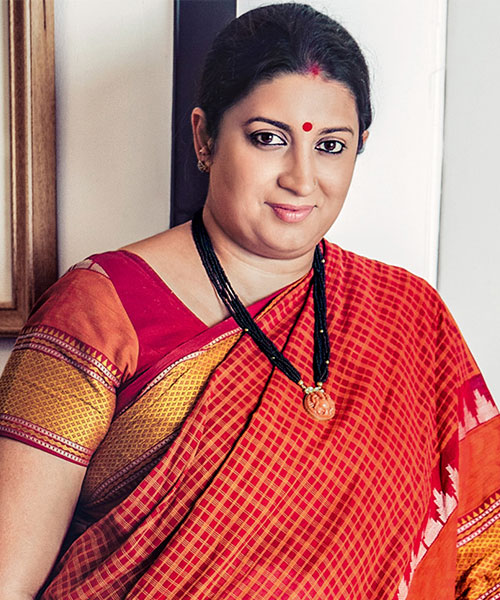
Tulsi, who had been relegated to oblivion in the BJP’s political soap opera, has suddenly made a comeback, once again in an equally formidable avatar. Ever since Smriti Irani’s stature rose in Nitin Nabin’s new team, with her appointment as a general secretary and given charge of two states, Haryana and Chhattisgarh, crowds have begun gathering around her once again. Speculation has now gathered momentum that she may contest the forthcoming Assembly elections from the Gauriganj constituency. Not only that, she may once again enter the fray from Amethi in the 2029 Lok Sabha elections. There must have been some reason that her residence in Gauriganj was recently renamed “Madhav Bhawan.” Another significant detail: Smriti Irani’s name has also been linked to the SIR process at the Leela Tikra booth in Gauriganj. Her enthusiastic supporters are already claiming that “if the BJP wins UP in 2027, Madam Irani will be a strong contender for Chief Minister”, a fact of which Yogi Adityanath is by now well aware.
Raghav may strike a new note
Raghav Chadha, once the apple of Arvind Kejriwal’s eye, had been gradually losing political relevance ever since he switched sides and turned saffron. It is said the BJP top leadership summoned him and assigned him an important responsibility: “It is equally necessary to explain the government’s narrative to the country’s youth who have taken to the streets demanding the resignation of Chief Election Commissioner Gyanesh Kumar.” Following this meeting, Raghav swung into action. He hurriedly invited more than 50 content creators and influencers for a meeting; most of them are old acquaintances from the days when he was a prominent face of the Aam Aadmi Party. Although the agenda of the meeting was officially stated as the coming Punjab elections, the reality may have been somewhat different. Immediately after Raghav’s meeting, social media was flooded with reels targeting the protesters in Delhi who were demanding Gyanesh Kumar’s resignation, reels that highlighted aspects of the agitation that were neither appropriate nor praiseworthy. Among these reel-makers were several sharp operators previously known (or notorious) for content against women and Dalits. Notably, on 25 October a Bharat Creators Conclave is being organised in New Delhi, where Raghav Chadha has been invited as the keynote speaker.
After Sudha, her son will get a promotion
In recent days, a prominent woman leader of the BJP, Sudha Yadav, has been appointed Governor of an important state like Karnataka. Earlier, BJP President Nitin Nabin had also given her son Siddharth Yadav a significant role in his team by making him the party’s National Media Co-coordinator. Siddharth is a lawyer in the Supreme Court and began his political journey with the Akhil Bharatiya Vidyarthi Parishad. He has been a student of Delhi University. He can often be seen strongly putting forward the BJP’s position on various national issues in TV debates and press conferences. Trusted sources linked to the BJP reveal that the saffron top leadership is somewhat upset with a prominent Yadav leader from Haryana, Rao Inderjit Singh, for certain reasons. He is the BJP MP from Gurugram and also a Minister of State with independent charge in the Modi government. Not only that, his daughter Aarti Singh Rao is a minister in Haryana’s Saini government. Perhaps the BJP high command is a bit irritated by their pressure politics, and also slightly uncomfortable with the fact that, contrary to BJP traditions, both father and daughter from the same family are currently ministers in different governments. Aarti is at present the Health Minister of the Haryana government. It is therefore being assumed that Siddharth Yadav is already being prepared for the 2029 Lok Sabha elections. It is quite possible that he may contest the Lok Sabha election in place of Rao Inderjit Singh. After all, Siddharth’s mother Sudha Yadav’s political journey has been extremely interesting. When Sudha’s husband was martyred for the country in the 1999 Kargil War, Narendra Modi was the in-charge of Haryana at that time. He had then proposed Sudha’s name from the Mahendragarh seat. Sudha’s husband, Deputy Commandant Sukhbir Singh Yadav, was posthumously awarded the Sena Medal for his unmatched bravery. Needless to say, Sudha won the 1999 Lok Sabha election from Mahendragarh. After that she held important positions in the BJP, remaining a member of the Central Election Committee as well as the party’s current Parliamentary Board. Now programmes of Siddharth have started being organised in places like Gurugram, Rewari and Narnaul. It is becoming clear that the BJP has already begun polishing him for the 2029 elections.
Delhi’s media at Chanakya’s lunch
On 15 October, the BJP’s Chanakya and the country’s Home Minister Amit Shah invited editors of major newspapers and channels for lunch at his residence. This was at a time when Delhi’s streets were so agitated against the Chief Election Commissioner. National Media Cell chief of the BJP, Anil Baluni, and former Union Minister Smriti Irani were also present on the occasion. Without any preamble or beating around the bush, the Home Minister came straight to the point. He told the editors: “The opposition is spreading a lot of confusion regarding SIR. Let us clarify this issue in today’s discussion, and I want to tell you that essentially this entire exercise is about stopping infiltrators.” A senior journalist mustered the courage to tell the Home Minister: “Sir, wouldn’t it have been better if you had held a press conference and placed all these points there?” Explaining to that journalist, Shah said: “That is exactly what we do not want. If I place my views publicly, you media people will yourselves say, see how the BJP has come out in support of the Election Commission.” After that, a long silence descended on the gathering.
SP-Congress Alliance May Challenge BJP in UP
The upcoming Uttar Pradesh elections are becoming increasingly interesting with the changing times. While various political parties and some independent agencies are continuously conducting opinion surveys across different regions of UP to gauge the public mood, one key point has prominently emerged from the results of these surveys: if the Samajwadi Party (SP) and Congress contest the elections together, they could be in a position to form the government. This is because the inclination of Brahmin, Dalit and Muslim voters currently appears to be towards the Congress, while Yadav, Muslim and, to a large extent, other backward class voters are leaning towards the SP. If both parties contest together, it would be highly advantageous for them; if they contest separately, the BJP would stand to gain. Meanwhile, a section of BJP leaders is putting pressure on the top leadership to merge the parties of Anupriya Patel, Om Prakash Rajbhar and Sanjay Nishad into the BJP before the elections. The fear is that these parties might switch loyalties after the election results. At the same time, the BJP once again wants to enter the electoral battlefield relying on Lord Ram (keeping the “Chanda Chori” issue aside for now). You can clearly sense the invocation of Ram’s name in the recent speeches of Rajnath Singh and Smriti Irani.