Tridib Raman
If religion is truly the opium, then lock it up in the basement of political ostentation. The byproduct that will emerge from it will be enough to intoxicate the innocent society. Now, when people like Dhirendra Shastri of Bageshwar Dham fame, allegedly prepared in the laboratory of the Sangh, start singing the discordant tune of Krishna versus Ram, understand that something is fishy. Its implications are steeped in the syrup of political jugglery. Identifying the intentions behind crafting and managing these narratives is therefore as necessary as identifying the real faces behind the masks of those who benefit from them. According to sources, keeping the 2027 Uttar Pradesh Assembly elections in mind, a plan for 100 days of kathas by Dhirendra Shastri across the entire state was already prepared. Its sole purpose was perhaps this: “When the sighs of the PDA were being heard loudly in UP, against that backdrop Shastri ji should call upon the Hindu masses to remain united, through his gestures, through kathas, through the tradition of narration, and through his expertise in crafting new narratives.” More than two dozen hosts who invited him for these hundred days had also been identified in advance; the list includes names ranging from Raja Bhaiya to bahubali Dhananjay Singh. In this sequence, Shastri ji is scheduled to stay in Agra for three days from 26–28 December as part of the Hanumant Katha programme following events in Kunda between 17–19 November. Preparations for his kathas have already gained momentum in places such as Gonda, Jhansi and Lucknow as well. Opposition parties allege that “ever since the saffron ‘tool kit’ became active, people like Dhirendra Shastri have come out into the open.” The money swirling around them is enough to leave both eyes and faith astonished at the same time, private planes, elaborate security arrangements, throngs of visiting leaders and officers, guards of honour. In such a situation, if the naïve narrator of God’s stories ever gets deluded and starts considering himself God, what is one to do?
Why Did Naidu and Stalin Change Their Stance at the Last Moment?
Tridib Raman
It has been about 85 days since the monsoon session of Parliament was adjourned indefinitely, yet the government appears to have failed in summoning the remaining part of the session. Although the monsoon session has not been formally prorogued, the government’s strategists have already begun preparations for the winter session. It is believed that the winter session can be summoned any time after the festive season, i.e., after 15 November. It usually runs till 20 December. It is said that the government’s strategists put in every effort to pass the bill amending the Women’s Reservation Law and the Delimitation Bill in the House, but the plan did not succeed. At one stage it appeared that the DMK had fully made up its mind to remain absent from the House on the day of voting on the delimitation bill; approaches were also being made to the SP to stay away. However, the way the political atmosphere has been resonating with the opposition’s bugle call for some time has forced parties such as the DMK and SP to rethink. Meanwhile, the way Chandrababu Naidu’s TDP changed colours also brought wrinkles to saffron brows. According to sources, Chandrababu wants to hand over the state’s throne to his son Nara Lokesh in the coming days. For this he is engaged in preparing a “safe passage” for his son without any hesitation; at such a time he cannot afford to take any political risk. On the other hand, he has instructed his party MPs that, whether Parliament is in session or not, they must stay in Delhi for three days a week. Their job will be to keep pressure on Delhi with files related to Andhra Pradesh projects. More or less the same is the situation with DMK supremo M.K. Stalin. In exchange for his undeclared help on the delimitation bill he had placed certain demands linked to the interests of the southern states before the central government, but he did not receive any concrete assurance. Stalin’s close confidants believed that “harmonising with the BJP’s tune, directly or indirectly, on the delimitation bill would be a politically suicidal step, the echoes of which could put the political future of his son and political heir Udhayanidhi Stalin at stake.” Perhaps keeping these reasons in mind, Stalin also withdrew his steps on the delimitation bill.
Why Is Yogi Losing His Say in BJP Ticket Distribution?
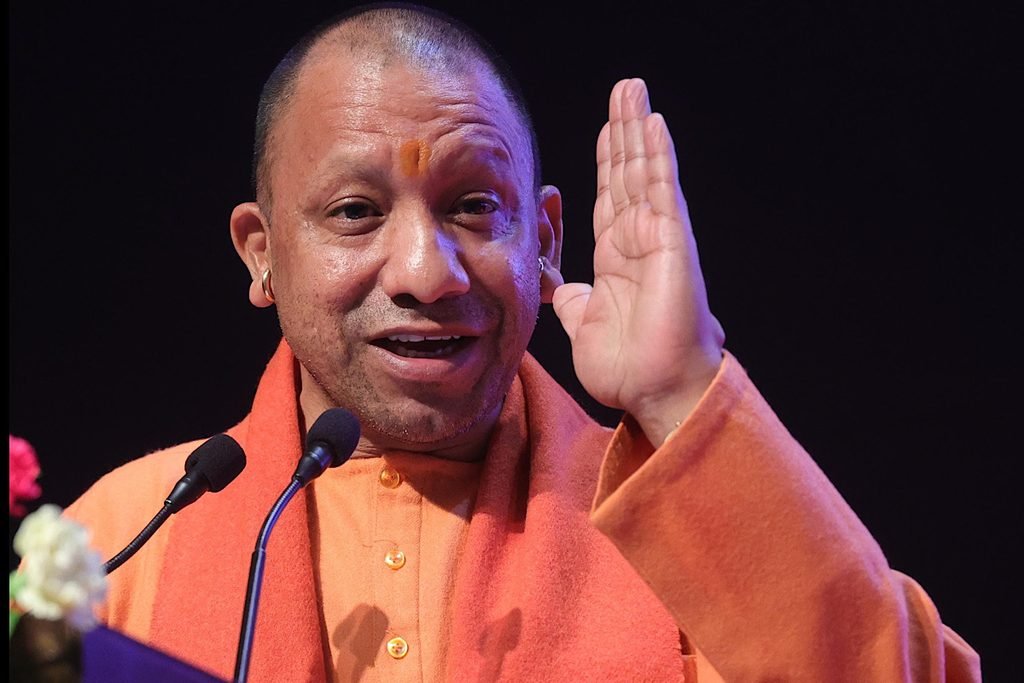
All is not well within the Uttar Pradesh BJP either. Despite repeated admonitions from Delhi, the infighting among party leaders in the state continues to take new forms, although much of it is being orchestrated behind the scenes. As the Assembly elections draw closer, ticket aspirants are changing their political strategies and trying out new manoeuvres. Some are making rounds of the RSS headquarters, others are frequently visiting Delhi, while several have pinned their hopes on Taware. A few are busy seeking the favour of Chief Minister Yogi Adityanath. However, at this crucial juncture, the BJP’s Chanakya and the central leadership in Delhi have made it clear that the greatest weightage in ticket distribution will be given to the winning prospects of potential candidates, as reflected in survey reports conducted by various agencies. Delhi has entrusted the maximum authority to its party General Secretary, Vinod Tawde. He will sit with the party’s Organisation General Secretary, Dharampal, State BJP President Pankaj Chaudhary and RSS representative Alok Kumar to finalise the list of ticket aspirants and submit it to the central leadership. The final list of candidates will be released only with Delhi’s approval. The question, however, is: where does this leave Yogi? He, too, has been working on preparing an entirely separate list of potential candidates, constituency by constituency. Will it really be so easy for Delhi to ignore Yogi? Sensing the political undercurrents, the astute Yogi has reactivated organisations such as the Hindu Yuva Vahini and the Bajrang Dal. Yogi is also fully aware that no matter how much Delhi flexes its political muscles, the key to the state’s resources remains firmly in his hands.
Is Omar’s new bride the ‘super CM’?
Jammu and Kashmir Chief Minister Omar Abdullah recently solemnised his second marriage with TV anchor Nidhi Razdan, but a storm of rebellion has broken out in his party. According to sources, at least 18 National Conference (NC) MLAs have adopted a rebellious tone against their own high command. It is also believed that these discontented NC MLAs enjoy tacit support from the BJP, which has conveyed to them the message that “if they increase the number of their colleagues to 20, the BJP can support them from outside to form the government.” It may be recalled that in the present Assembly the NC has 41 MLAs, the Congress has 6, and Omar also has the support of 6 Independents plus one other MLA, giving him the support of 54 legislators in the House. The majority mark for government formation is 46. Discontent against Omar has long been simmering within his party. The common complaint of party MLAs is that “Omar is extremely arrogant and stubborn by nature; he does not even prefer to meet party MLAs. So far he has only enjoyed the benefit of his father Farooq Abdullah’s charismatic personality and leadership. Even today, party leaders and MLAs do not ignore Farooq’s word. Whenever a crisis arises in the party, Farooq emerges as the crisis manager.” On the one hand, most party MLAs are troubled by the Centre’s dual power policy; on the other, Omar prefers not to step out of his “comfort zone.” In recent days, when the party was grappling with a severe internal crisis, Omar remained busy with the formalities of his wedding and reception. He was so occupied that even his ministers could not locate him for three days. Some MLAs have also complained in hushed tones that ever since Nidhi formally entered Omar’s life, the culture of the party itself has changed. Important decisions related to the party and Omar are now being taken by Nidhi; party people have therefore begun referring to her as the “Super CM.” Even access for national and local media is now possible only with Nidhi’s consent.
Why Is the National Conference Facing a Revolt?
The common complaint of party leaders and MLAs against Omar has mostly been that he remains unavailable to them. With the intention of resolving the matter, Omar had earlier made his political advisor Nasir Aslam Wani the heir to all his political powers. Wani is a leader who has lost elections, yet gradually he too maintained a distance from party workers and MLAs. As a result, the lava of discontent within the party began to erupt further. Party leaders and MLAs repeatedly conveyed their objections regarding Wani to Omar, but the situation remained unchanged; Wani continues to be the biggest power centre in Omar’s court. Recently Omar expanded his cabinet and inducted four new ministers, including seven-time MLA Ali Mohammad Sagar. Sagar’s son Salman Sagar is the MLA from Hazratbal. Meanwhile, another seven-time MLA, Mubarak Gul, is angry over Sagar’s induction as a minister. The party’s Srinagar Lok Sabha MP, Aga Ruhullah Mehdi, has resigned from his Lok Sabha seat and has also quit the party. In the meantime, Mubarak Gul was about to hold a press conference along with the angry MLAs, but at the last moment Farooq Abdullah somehow persuaded him and the press conference was postponed for the time being. The demand of the angry MLAs now is that Omar should reconstitute the cabinet afresh, and that Deputy CM and CM’s advisor Aslam Wani should be removed within two weeks. Sensing the delicacy of the situation, on Friday, 6 November, Farooq called a meeting of the discontented MLAs in which Omar was also present. It is said that the meeting became so stormy that Omar announced his resignation from his post and started leaving the meeting. Farooq then with great difficulty persuaded his son and assured the angry MLAs that, along with Wani, another political advisor would be appointed soon, someone of their choice. Only then has the matter been temporarily calmed.
Does Trump Have an Aversion to Indians?
In the US midterm election results, the blue colour of the Democrats has waved the flag of victory over the red of Trump and the Republicans, and Trump has almost lost control of both houses of Congress. Despite this, his arrogance shows no sign of softening, especially, no significant change is visible in his attitude towards Indians. As soon as the election results came in, Trump’s anger was directed at White House Chief of Staff Susie Wiles, who until now was counted among Trump’s most favoured advisors. Trump has handed over this new responsibility to Stephen Miller in place of Susie. Miller has been notorious for his hateful attitude towards immigrants, especially Indians. The idea of the “hard-line immigration policy” and “mass deportation”, when Indians were sent back to their country in handcuffs, is attributed to Miller. Miller is considered the architect of the harsh immigration policy and mass deportation. This also indicates that even after losing majority in both houses of Congress, Trump will continue to support Miller’s harsh and inhumane policies on immigration in the future. It may be recalled that Miller comes from a Jewish family. From the age of just 15–16 he has held a hateful view towards immigrants, especially “Asian immigrants,” and in politics too his image is that of an extremely hardline leader.
Mehbooba Mufti’s Political Reinvention
Is PDP leader Mehbooba Mufti trying to wash away the sins of her political past? Her rival party in the state, the National Conference, has attempted to portray her as a villain, telling the public that she was the one who paved the way for the BJP’s entry into Kashmir and subsequently formed a government in the state in alliance with the BJP. It is also widely believed that former Prime Minister Atal Bihari Vajpayee played a significant role in the formation of the PDP. Now, Mehbooba appears keen to soothe the painful memories that continue to haunt the people of Kashmir. She has begun reaching out to the Congress and strengthening her ties with Sonia Gandhi. At the INDIA bloc rally held at Ramlila Maidan on November 1, she was also prominently seen sharing the stage with other alliance leaders.