Tridib Raman
The turbulent political situation in Bihar seems to have struck like a storm. In the stillness and silence that now hangs heavy, this Bihari stalwart may take some time to rediscover his once-glorious past. Yet, it does not appear that the “Sushasan Babu” of yesterday has completely surrendered before today’s saffron aura. Those political strategists who had been weaving plans to sideline him from Bihar, based on his expressive demeanor and somewhat unsettled state of mind, have now realized that, although this warrior may look exhausted and drained in the current political battlefield, he is not defeated. He is preparing himself just as firmly for a counterattack. On Wednesday, the moment the BJP’s master strategist signaled his most trusted disciple, Samrat Chaudhary, to be ready for coronation, Nitish stepped out of his adopted composure. His disagreements began to take clear shape almost immediately. According to sources, even before Samrat could move toward the throne, Nitish had already made his opposition known. Sources also suggest that Nitish insisted on speaking directly with the Prime Minister, and the conversation did take place. He openly expressed his concerns. His emphasis was primarily on three points: First, the next Chief Minister of Bihar should be chosen with his consent. Second, in the new political arrangement, the Assembly Speaker must be from his party, the JD(U). Third, and most importantly, the Home Department should remain with JD(U). The saffron strategists advocating for Samrat Chaudhary have their own arguments. They point out that Samrat belongs to the Koeri caste, which holds influence not just in Bihar but also in Uttar Pradesh and Jharkhand, potentially benefiting the BJP in the upcoming 2027 UP elections. Another argument in his favor is his strong, assertive leadership image; they believe he is the only one capable of effectively countering Tejashwi Yadav in Bihar. Interestingly, Samrat also shares a close rapport with Nitish’s son, Nishant Kumar. Lately, those close to Nitish have been working to position Nishant as his true political heir. It is said that even the Prime Minister agrees with Nitish on one point, that whoever succeeds him in Bihar should have a clean image and the ability to transfer Nitish’s voter base to the BJP. For now, the question of Nitish’s successor in Bihar appears to have become further entangled in new political complexities.
What’s on Raghav’s Mind?
Tridib Raman
Raghav Chadha, once counted among Arvind Kejriwal’s closest protégés, now appears in a new, rebellious avatar. Tensions between the AAP leadership and Raghav have been simmering for months. The party supremo, it is said, has already understood the reason why this sudden rebellion has begun to take shape, and how the subtle echo of the lotus seems to have found a place in Raghav’s mind. Ever since his marriage to Bollywood actress Parineeti Chopra, observers say Raghav’s political leanings have begun to tilt saffron. This perception is linked to Parineeti’s cousin, Priyanka Chopra, who is believed to have considerable goodwill within BJP circles. This connection, some suggest, has opened doors for Raghav into a more comfortable engagement with the saffron ecosystem. In February, when top AAP leaders like Manish Sisodia and Kejriwal were acquitted in the alleged Delhi liquor policy case, Raghav maintained a conspicuous silence. The party even organized a major rally at Jantar Mantar, yet he was notably absent. It is said that Kejriwal had asked Raghav to raise key issues in the Rajya Sabha, such as the arrest of over 150 party workers in Gujarat and the alleged withholding of central assistance to Punjab. But Raghav appeared preoccupied with entirely different concerns; raising issues like overpriced samosas at airports and food adulteration. Initially, the responsibility of engaging with him was handed to Sanjay Singh. However, Singh reportedly observed that Raghav was consciously distancing himself from party activities, while increasingly gravitating toward BJP circles. He is believed to have informed Kejriwal that during parliamentary sessions, Raghav was often seen spending time in the offices of Piyush Goyal and Kiren Rijiju. There are also claims that, at the behest of a Union minister, a top industrialist linked to the BJP arranged a substantial monthly retainer for Raghav’s CA firm. For now, Raghav portrays himself as sidelined within the party, insisting, “I am not defeated, I have been silenced.” But sources within AAP suggest otherwise. They claim he is effectively playing into the BJP’s hands, allegedly tasked with engineering a split within Punjab AAP ahead of elections, encouraging Bhagwant Mann to chart a separate course and attempting to break away a significant chunk of the party’s MLAs. For Raghav, this is no small challenge, it may well define his political future.
Why did the Alliance with Akalis break?
Tridib Raman
There were clear indications for a while that the Shiromani Akali Dal and BJP were set to form an electoral alliance for the upcoming Punjab Vidhan Sabha elections, and that both parties would contest the elections together. First Sukhbir Badal, then Harsimrat Kaur Badal, met with Amit Shah, and discussions on the alliance formula began. After that, the BJP formed a team led by its Delhi government minister, Manjinder Singh Sirsa, and tasked this team with presenting a detailed analysis prepared on the basis of ground reports from all 117 seats in Punjab to the BJP. Before this, the BJP had already called for a report from the Intelligence Bureau (IB) on all these 117 seats. The gist of both reports was similar: it stated that while the Akali Dal Badal transfers the BJP’s traditional Hindu votes to their side, their core vote bank (Jat Sikhs) does not get transferred to the BJP. In fact, where the BJP fields a candidate instead of the Akali Dal, these Sikh votes either go to the Aam Aadmi Party (AAP) or the Congress. Besides, most leaders of the Punjab BJP are from the ‘Bhapa’ (trader or Khatri caste) community; Sirsa himself is a ‘Bhapa’ i.e., Khatri Sikh. The party still does not have any Jat Sikh leader with a mass following who could bring those votes to the BJP’s side. So, the BJP strategists have decided to try out the Haryana election formula in Punjab. During the Haryana Vidhan Sabha elections, on most seats in South Haryana where the BJP appeared weak, the RSS and BJP cadre heavily focused on the ‘Purabia’ voters (from Bihar/Uttar Pradesh). They won the ground solely because of these voters. In Punjab too, there are over 50 such assembly seats (especially in Ludhiana, Jalandhar, and Chandigarh) where 30-60 percent of voters are ‘Purabia’. So, this time too, the BJP strategists want to bet on these ‘Purabia’ voters. The BJP is hoping that if they win a decent number of seats in this election, they can then form a post-poll alliance with the Akalis to form a government and also demand a Chief Minister on a rotational basis.
When will Priyanka’s wish be fulfilled?
Tridib Raman
Priyanka Chaturvedi has just retired from the Upper House, but she has already started preparing for her comeback. After bidding farewell to the Rajya Sabha, she has hosted at least five parties, one for journalists, one for women journalists, and one for her parliamentary colleagues. The agenda of all these parties was the same: keep Priyanka’s name buzzing, keep the reels coming, and keep discussing even unnecessary issues along with important ones. But the biggest question now is: who will bring her back to the Rajya Sabha? Poor Aditya Thackeray can’t do much, this time Shiv Sena (Uddhav) is nowhere near the required numbers. It is said that Priyanka made several rounds to Devendra Fadnavis too, but nothing worked out there either. Then she turned to Eknath Shinde, but even Shinde did not have the necessary numbers or inclination to oblige her this time. So she used Jaya Bachchan as an intermediary to approach Samajwadi Party supremo Akhilesh Yadav. Jaya Bachchan herself went to Akhilesh to plead Priyanka’s case. It is said that as soon as Jaya met him, Akhilesh told her: “Your word is something else, we have great respect for your family, but what is the utility of this lady for us? Anyway, how long can we keep sending outsiders from our party to the House? It sends the wrong message to our own party cadre.” Even though all political paths seem closed for Priyanka Chaturvedi at the moment, she is an expert at finding a new way.
KC’s Efforts did not Bear Fruit
Tridib Raman
KC Tyagi had been wanting for a long time that if he ever said goodbye to JD(U), he would straight away join the Samajwadi Party. That is why even before officially leaving JD(U), he had started meeting SP supremo Akhilesh Yadav. But Akhilesh did not seem very enthusiastic about bringing him into the party. He felt that KC’s entry would not bring any special benefit to the SP. Secondly, he also felt that KC is a seasoned politician and would definitely demand something big in return for joining. So, Akhilesh assigned the task to Professor Ramgopal Yadav: “Talk to KC Tyagi and find out what exactly he wants.” Even after that, KC Tyagi visited Professor Ramgopal’s house twice. Every time, the same rehearsed line came: “You are heartily welcome in the SP.” But he never disclosed what deal he was offering in return. When KC realised that the Professor was just dodging and had nothing concrete to offer, he went straight to Jayant Chaudhary. Jayant Chaudhary turned out to be smarter. Right at the beginning of the conversation he told KC Tyagi that he would field KC’s son from the RLD ticket from Murad Nagar in the 2027 UP Assembly elections. So, a father happily agreed to the proposal for the bright future of his son.
Will Mamata’s Gamble Pay Off?
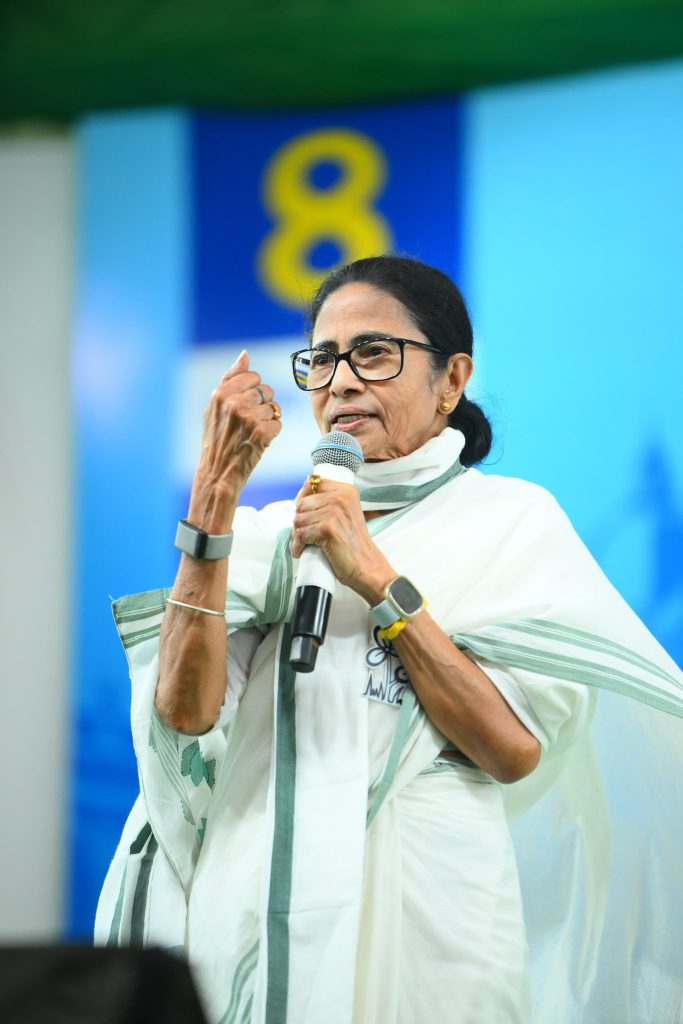
The electoral battle between the Trinamool Congress and the BJP in the Bengal elections has now reached an intriguing turning point. Both parties are deploying every possible tactic – persuasion, resources, pressure, and strategy – in equal measure. On one hand, the BJP has poured its full strength into the election, mobilizing its resources, organizational machinery, finances, and cadre. On the other hand, Mamata Banerjee is responding with equally forceful counterattacks. Mamata is determined to frame this entire election as a contest between “Bengali identity versus outsiders.” This is why she continues to sharpen her campaign rhetoric with each passing day. Her latest move has been to bring the issue of non-vegetarian food into the debate. She is telling Bengali voters that if they make the “mistake” of bringing the BJP to power in the state, the party could impose restrictions on the consumption of meat and fish. Using the SIR issue as a plank, Mamata is also trying to convince poorer voters that the BJP intends to deprive them of their voting rights. At the same time, Mamata is putting in a concentrated effort in North Bengal. In the 2024 Lok Sabha elections, the BJP won 5 out of 8 seats in the region, and in 2019, its performance was even stronger, securing 7 out of 8 seats. This time, Mamata is determined to break that BJP stronghold in North Bengal.
A United Gogoi Challenge to BJP
Assam’s elections are gradually becoming increasingly crucial for the BJP. In the 2021 assembly elections, the Congress managed to win only 5 out of 34 seats in Upper (Eastern) Assam. This region has a strong presence of Gogoi, that is, Ahom voters. This time, all three prominent Gogoi leaders have come together in support of the Congress, raising expectations that the electoral results in Upper Assam could witness a major upset. Raijor Dal chief Akhil Gogoi, former AASU leader Lurinjyoti Gogoi, and Assam Pradesh Congress chief Gaurav Gogoi are jointly contesting in the region. Moreover, the Congress has already formed an electoral alliance with Raijor Dal and the Assam Jatiya Parishad
